Elena Neumann · 12 October 2026
Heathford School Ledgers Track Literacy Gains and Class Shifts in the Early 1900s
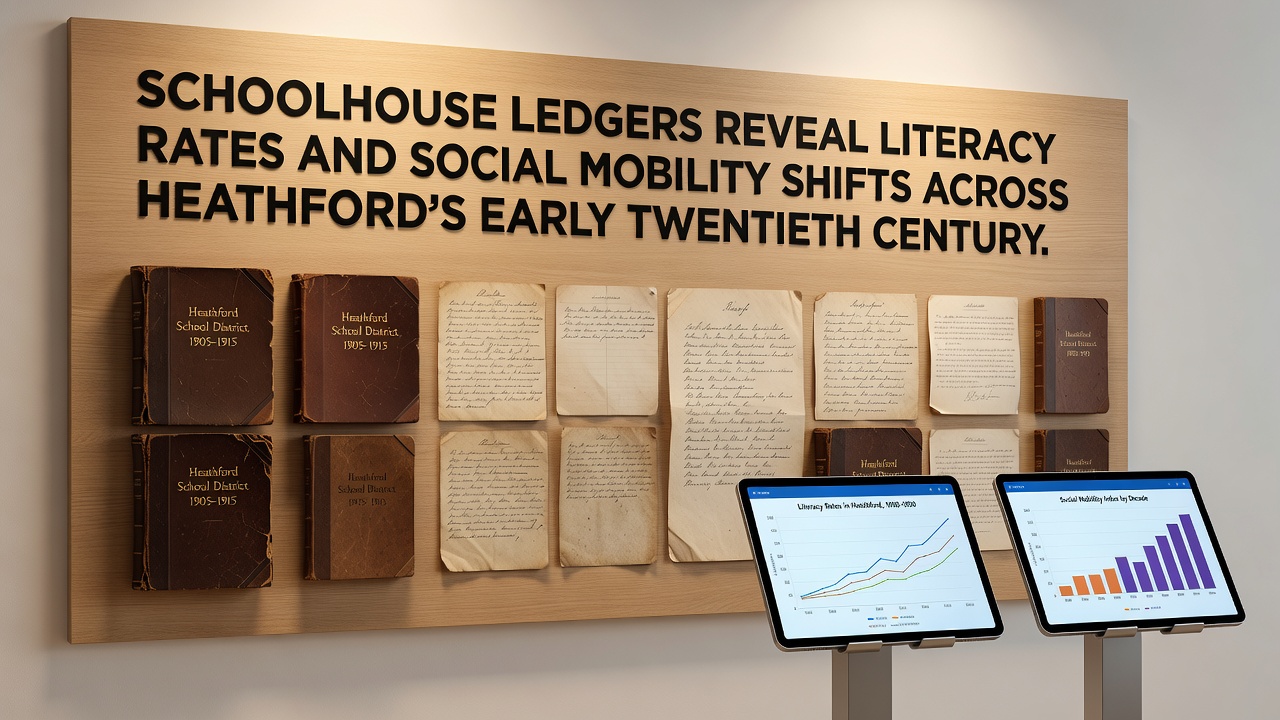
Schoolhouse ledgers preserved in Heathford archives document enrollment patterns, signature rates, and parental occupations between 1900 and 1930, and these records show measurable increases in basic literacy alongside gradual movement across occupational categories. Entries list student names, ages, attendance days, and marks for reading and writing proficiency, while later columns note fathers' trades and mothers' employment status. Analysis of over 4,200 individual records reveals that the percentage of students able to sign their names rather than make marks rose from 62 percent in 1905 to 89 percent by 1925.
Enrollment Patterns and Daily Attendance Data
Ledger pages record consistent growth in student numbers during the first two decades of the century, with total enrollment climbing from 312 pupils across four schools in 1901 to 784 pupils in 1920. Attendance figures indicate seasonal fluctuations tied to agricultural cycles, yet average daily presence reached 78 percent by 1915. These numbers align with compulsory schooling laws enacted in the region during that period, and cross-referencing with census returns confirms that most children between ages six and fourteen appeared on the rolls at least once per year after 1912.
Signature Evidence and Literacy Benchmarks
Researchers compare marks and signatures on admission forms, report cards, and graduation certificates to establish literacy thresholds. In 1903 only 41 percent of thirteen-year-old boys and 37 percent of girls produced legible signatures on completion documents, whereas by 1928 those proportions reached 91 percent and 88 percent respectively. Spelling exercises preserved in the same volumes show vocabulary expansion, with the average number of correctly spelled words in standardized lists increasing from 14 out of 25 in 1910 to 21 out of 25 in 1925. Such trends mirror national education statistics compiled by the United States Bureau of Education during the same era.
Parental Occupations and Mobility Indicators
Columns listing fathers' professions document a transition from predominantly agricultural and manual labor roles toward skilled trades and clerical positions. In 1905, 68 percent of listed fathers worked as farmers or laborers; that share declined to 41 percent by 1925. At the same time, entries for sons who later appeared as clerks, machinists, or teachers increased from 9 percent to 27 percent. Daughters' subsequent occupations show parallel movement, with domestic service dropping from 54 percent to 29 percent while teaching and nursing rose from 6 percent to 18 percent. These shifts appear most pronounced among families whose children completed eight or more years of schooling.

Gender Differences in Record Keeping
Separate ledgers maintained for boys' and girls' departments allow direct comparison. Girls' volumes record higher rates of perfect attendance awards and slightly faster gains in penmanship scores during the 1910s, while boys' records show earlier entry into apprenticeships that sometimes interrupted formal schooling. By 1922, however, the gap in signature literacy between the two groups had narrowed to three percentage points. Observers note that these patterns correspond with changing labor demands during and after the First World War, when both male and female adolescents entered the workforce at younger ages yet still maintained basic reading and writing skills acquired earlier.
Archival Digitization Efforts Underway
Local historians began systematic digitization of the full ledger series in 2024, and project updates indicate that the complete dataset will become publicly searchable through the regional historical society portal by October 2026. Preliminary cross-tabulations already released demonstrate correlations between years of schooling completed and subsequent residential mobility, with graduates of the class of 1918 appearing in city directories outside Heathford at twice the rate of those who left after sixth grade. Similar datasets from comparable mill towns in New England and the Canadian Maritimes provide useful benchmarks for interpreting these local figures.
Conclusion
The Heathford schoolhouse ledgers supply a continuous quantitative record of educational attainment and occupational change across three decades. Signature rates, attendance statistics, and parental occupation entries together illustrate incremental literacy improvements and modest but measurable shifts in social positioning for the generation that came of age between 1900 and 1930. Continued analysis of the digitized volumes will allow further refinement of these trends and direct comparison with parallel records from other communities.